Don't do it alone.
Our goal is to make business easy. We’ve got experts available by phone to answer questions, 7 days a week. Let us handle the details so you can focus on what you do best.
Contact us

STEP-BY-STEP S-CORP SETUP
Maximize your profits by filing as an S-Corp.
We handle the paperwork, you save money.
Is an S-Corp right for you? Compare here.
Compare packages
Our customized packages meet the compliance, filing speed, and support needs of your new business in one place.
starter
 Basic
Basic
Covers all your required filings with the state, accuracy guaranteed.
+ state fees
 Process in 7-10 business days*
pro
 Most Popular
Everything to start and protect your LLC and keep it compliant year-round.
+ state fees
 Processes in 1 business day*
premium
 Best Value
Get additional tools and expert support to start and grow your business online
+ state fees
Processes in 1 business day*
*Processing times are based on receiving complete information. ZenBusiness processing times do not include Secretary of State processing times, which can vary.
**SPECIAL OFFER – Starter includes one optional free year of Worry-Free Compliance (renews at $199/yr).
Start Strong. Stay Compliant.
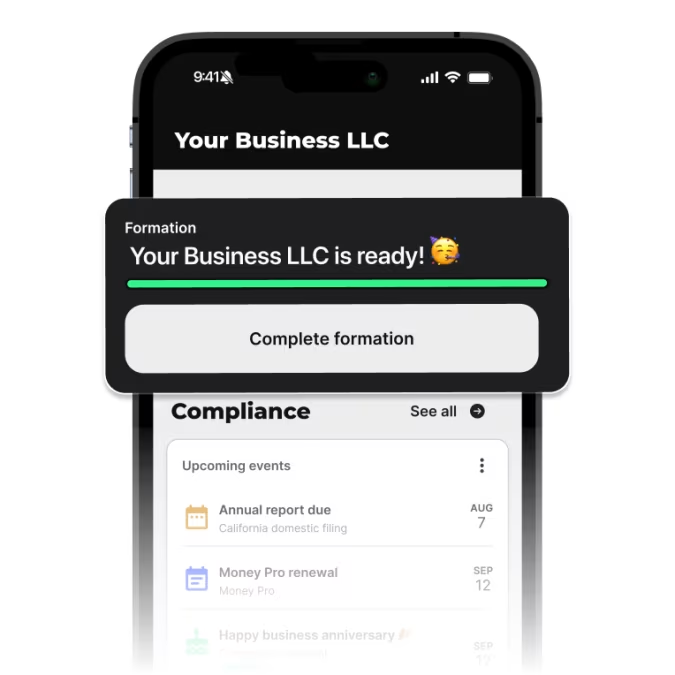
Start with confidence and stay protected as you grow with best-in-class services and support.

Fast, Accurate Formation
File confidently with fast processing and our accuracy guarantee.

Registered Agent Service
Meet the state requirement to have a dedicated registered agent.

Ongoing Compliance Filings
Stay compliant with ongoing annual report and amendment filings.

Manage and Grow Your Business
Get your business online and set up your banking and finances.

Award-Winning Support
Industry leading support by phone, chat, or email 7 days a week.
Don't do it alone.
Our goal is to make business easy. We’ve got experts available by phone to answer questions, 7 days a week. Let us handle the details so you can focus on what you do best.
Contact us
Amike Dynasty
1 review US
US

A big shout out to Pierina D
A big shout out to Pierna D. Thank you for taking your time and explaining the steps to me as I was overwhelmed. Thank you for being so calming and nurturing I will 1000% recommend people just because of the service that you gave me thank you so much and like I told you, you need a raise. God bless.
Christian Friedrich
1 review
US
Evan helped me getting my website…
Evan helped me getting my website published with ease! Turns out I had screwed up a few things on my end but he was kind enough to fix the discrepancies and getting everything taken care of; all within a few minutes!
Maegan
2 reviews
US
Continually friendly service from ZB
Continually friendly service from ZB. I called their support line and received amazing help from Josh. After a long stressful day, he managed to put a smile on my face and was able to help me resolve my issue.
Rick B
1 review
US
I had no idea what to do to form my LLC…
I had no idea what to do to form my LLC. Zen made it painless and easy with multiple plans to choose from. Everything was A-plus handled and explained
Timothy Baxter
1 review
US
Great package deals with Zen Business
Zen Business gave me easy access to packages that are affordable and very helpful. The website page was easy to use and explained everything perfectly. Great job by Zen Business in creating such a great business format.
Rodney Williams
1 review
US
Tanisha G was outstanding
Tanisha G was superb. Thoughtful, insightful, proactive and most of all patient! I’m an instant and grateful fan
Starts at $0 plus state fees and only take 5 to 10 minutes
An S-Corporation is not a business structure or separate legal entity like a corporation or LLC. Rather, it’s a tax classification that either an LLC or a corporation can apply for with the Internal Revenue Service (IRS) if it meets the criteria.
For an LLC, filing as an S-Corporation may provide savings on self-employment taxes in some cases. For C- Corporations, it can be a way to avoid double taxation.
To qualify for S-Corporation status, a business must meet the following requirements:
In order to get S-Corporation status, you must first become an LLC or a corporation, both of which provide limited liability protection.
S-Corporation advantages include:
An LLC is a legal business structure, whereas an S corp is a tax filing status.
S-Corp status may not be right for all businesses. If you’re not sure whether to identify your LLC as an S- Corp or keep the default status, be sure to consult with an experienced business law attorney or accountant in your state.
The S corporation tax status allows an LLC’s members to be employed by the LLC, which can reduce the amount of taxes they must pay for Social Security and Medicare. For a corporation, S corporation election allows the corporation to avoid double taxation.
A C-Corporation is the default form of corporation and a separate legal business entity. An S-Corporation is just a tax election that can be made by either a Corporation or an LLC.
Yes, your company will still remain an LLC business structure, but it can be taxed as an S-Corp. To request that the IRS taxes your LLC income as an S-Corp, you need to complete Form 2553, Election by a Small Business Corporation, to be treated as an S corp instead of an LLC.
If your LLC is past the 75-day election deadline, you’ll also need to file Form 8832, Entity Classification Election, to elect to be taxed as a corporation. Then you would file both Form 8832 and Form 2553 together via USPS-certified mail.
Yes, your company will still remain an LLC business structure, but it can be taxed as an S corp. ZenBusiness can assist, though it involves a $200 service fee if done after 30 days of LLC formation. The customer must sign and mail the S corporation election form to the IRS. This service is only available to LLCs formed with ZenBusiness.
If your LLC is past the 75-day election deadline, you’ll also need to file Form 8832, Entity Classification Election, to elect to be taxed as a corporation. Then you would file both Form 8832 and Form 2553 together via USPS-certified mail.
The process for filing an S corp involves preparing and submitting Form 2553 to the IRS, which requires a wet signature. ZenBusiness can prepare the form, but the customer must sign and mail it to the IRS.
Calculating taxes can be confusing, but you can check out our S corp tax guide to learn more about navigating taxes for your S corp. A certified tax professional can give you more definitive information for your circumstances.



Scan to download
the ZenBusiness app